Investor buying guide
Startup Team Risk Assessment
Assess startup team risk before investing: founder commitment, equity, decision-making, and alignment. Explore ETA Scan, backed by 20,000+ teams assessed.
A startup team risk assessment helps investors examine whether founders are aligned and equipped to execute the business plan. It brings commitment gaps, unclear decision rights, equity expectations, and differences over funding into the diligence conversation. This guide explains what to assess, what a useful report should show, and how to put the findings to work before investing.
The essentials
- Assess founder commitment, role coverage, ownership, decision-making, and shared expectations.
- Look for findings connected to founder responses and practical diligence questions.
- Turn the report into an action list for founder conversations and the investment memo.
1. Start with the founding team's execution risks
A compelling market and a strong product still need a team that can deliver. Start by identifying the founder decisions and working arrangements on which the next funding period depends: who builds the product, who wins customers, who controls spending, and who leads the next raise.
Look for points where the operating plan depends on an unresolved team agreement. A founder's transition to full-time work, a disputed division of responsibilities, or conflicting expectations about equity can all create questions worth resolving before capital is committed.
- Map the founder responsibilities behind the next milestones.
- Identify team agreements that the operating plan depends on.
- Prioritise the questions that could change the investment decision.
2. Define the team risks worth investigating
A useful team assessment makes operational questions more visible. Do founders agree on their responsibilities? Is available time consistent with the milestones? Are ownership expectations understood? Can difficult decisions be resolved? Do the founders share expectations about funding and the future of the business?
Connect each finding to the operating plan. If a founder is part-time, establish who covers critical delivery work. If decision rights overlap, ask how a recent disagreement was resolved. If funding expectations differ, agree what runway and growth assumptions the team is working toward.
- Assess commitment against the delivery plan, not a label alone.
- Explore decision-making, role coverage, and ownership arrangements separately.
- Ask how differences in founder expectations are interpreted and followed up.
Illustrative risk signal
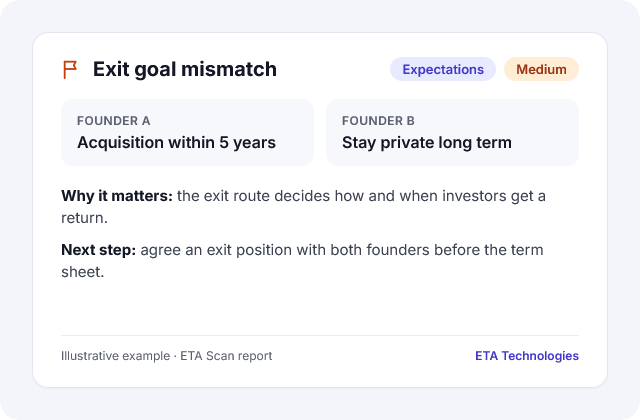
One founder expects to raise another round within twelve months; another expects the company to remain bootstrapped. Ask them to agree a financing plan, the milestones it depends on, and the conditions that would trigger a change.
3. Compare individual founder perspectives
Ask founders the same questions separately before the joint discussion. Compare their expectations for time commitment, responsibilities, compensation, ownership, funding, and exits. Individual answers give the investor a more detailed view than a single, rehearsed pitch.
Use the comparison to focus the conversation. For each material difference, ask the founders to explain their positions and agree the next step. Keep the original responses alongside the discussion notes so the investment team can follow how the issue was resolved.
- Collect individual answers before the joint founder discussion.
- Compare expectations across the same set of questions.
- Clarify what data is required, who can access it, and what the provider stores.
4. Prefer evidence-led outputs over unexplained scores
A single score can be convenient for sorting, but it can conceal why a team deserves attention. Ask for a sample report and follow one observation from the input through the interpretation to the recommended follow-up. The investor should be able to identify which supplied information supports the concern and what remains unknown.
A useful report separates the finding, its supporting information, and the next diligence question. It should help the reviewer prioritise material issues and turn each one into an action with an owner. Ask for a worked example that you could use in an investment committee discussion.
- Trace a sample concern back to its underlying information.
- Check whether uncertainty is visible beside the observation.
- Ask for useful follow-up questions, not just a colour or ranking.
A report worth discussing
The report flags different expectations about founder availability, identifies the responses behind that observation, and suggests confirming a transition date and delivery coverage. That is more actionable than an unexplained 'high-risk team' label.
5. Evaluate the assessment method and experience
Look for experience with startup teams and a clear explanation of the risk patterns being assessed. Ask how the method connects founder responses to findings, how those findings are prioritised, and how they become useful diligence questions.
Review a sample report against a team situation you understand. Follow a finding from the founder responses through the analysis to the suggested conversation. This gives you a concrete basis for comparing providers and choosing an assessment that fits the fund's review process.
- Ask about experience assessing startup teams.
- Review which team risk patterns the method covers.
- Follow a sample finding through to its recommended diligence question.
6. Test how the tool fits the investment workflow
The useful output is a better diligence conversation and a clearer investment memo, not another place to check. Decide when the assessment would run, who reviews it, and how material questions are passed to founders or advisers. Test whether the result can sit beside the existing deal notes and evidence log.
Consider the founder experience as well. Explain why the information is requested and how it will be used. Ask the provider about questionnaire length, accessibility, handling of incomplete responses, and the process for resolving follow-up questions. Schedule the assessment early enough to discuss the findings before the investment committee meets.
- Assign responsibility for reviewing and following up the report.
- Test how observations enter the deal tracker and investment committee materials.
- Confirm access, retention, export, and deletion arrangements before using real founder information.
7. Run a small, decision-focused evaluation
Before using a product across the pipeline, define what would make a trial useful. For example, can it surface a question the existing process missed, make uncertainties easier to explain, or organise follow-up more consistently? Review sample reports first, and use real founder information only with appropriate authority and agreed data handling.
Compare the output with the diligence record. Track which observations led to a new question, a clarified agreement, or an action before signing. Ask the reviewers whether the assessment helped them focus the founder discussion and prepare the investment memo.
- Agree evaluation criteria before reviewing the output.
- Record whether suggested follow-ups materially improve the review.
- Review investor and founder feedback before expanding use.
Assess your next startup team with ETA Scan
We've assessed 20,000+ startup teams. Our assessment analyses 25+ team risk patterns, giving investors a structured way to explore founder commitment, expectations, and alignment before investing. Founders answer separately, making individual perspectives visible before the joint discussion.
ETA Scan turns that comparison into a report you can use in your next founder conversation. Focus on the differences that matter to the operating plan, agree follow-up actions, and bring the findings into Google Sheets, Excel, or your existing deal-flow process.
Get your first scan free. Book a call with us to get a team started and see how the report fits your investment review.
Common questions about startup team risk assessment
When should a startup team risk assessment run? Use it once a team enters serious diligence, with enough time to discuss the findings before the investment committee or signing. It can also structure a team review ahead of a follow-on round.
Which risks should the assessment cover? Focus on commitment, role coverage, decision-making, ownership expectations, and alignment on growth, funding, compensation, and exits. Prioritise findings that affect the next operating milestones.
What should investors do with the report? Use the findings to prepare targeted questions, clarify founder agreements, and record next actions in the investment memo. Assign an owner and a deadline to each material follow-up.
Further reading
Start with your next founding team
Put our experience assessing 20,000+ startup teams to work in your next investment review. Book a call to get your first scan started, free.
Get your first scan free