Investor field guide
Founder Due Diligence Checklist
A practical founder due diligence checklist for startup investors: verify commitment, equity, roles, references, and team alignment before investing.
A founder due diligence checklist turns a convincing pitch into claims an investor can verify. Use this seven-step review to check experience, commitment, ownership, decision-making, and alignment before committing capital. Each step gives you specific questions, evidence to request, and a clear next action.
The essentials
- Check founders separately, then reconcile their accounts with documents and references.
- Review commitment, decision rights, ownership, and shared expectations as distinct workstreams.
- Record unresolved questions and evidence quality rather than treating missing information as proof of a problem.
1. Define the decision and the scope
Start with the investment decision the review is intended to support. A first angel investment, a follow-on round, and admission to an accelerator may require different levels of checking. Write down the founder claims that could materially change that decision: full-time availability, relevant experience, ownership of the product, responsibility for customer acquisition, or a previous working relationship.
Keep the founder review connected to the wider deal. Assign financial, legal, commercial, and technical checks to the appropriate workstreams, then focus this checklist on the people responsible for execution.
- Identify the decision, investment stage, and material founder claims.
- Agree which checks need professional advisers and who owns each follow-up.
- Request only relevant information and handle personal data lawfully and proportionately.
2. Verify relevant experience and references
Translate broad statements such as 'built the previous product' or 'led enterprise sales' into specific responsibilities, dates, and outcomes. Ask what the founder personally delivered and which colleagues can describe that contribution. Distinguish participation in a successful company from ownership of the work that made it successful.
Ask references how the founder handled missed milestones, difficult feedback, and changes in responsibility. Where dates or responsibilities differ between accounts, ask the founder to reconcile them and record the explanation.
- Reconcile relevant roles and dates with appropriate records or references.
- Ask references for examples of execution and collaboration.
- Record what a reference directly observed versus what they heard from someone else.
A useful reference question
Which important decision did this founder own, what happened, and how did they respond when the result differed from the plan?
3. Check time commitment against the operating plan
Full-time or part-time is only the starting point. Compare actual availability with the work required over the next funding period. A technical founder contributing ten hours each week may be sufficient for a narrowly scoped prototype and insufficient for a complex deployment. The diligence question is whether the operating plan accounts for that constraint.
Ask about outside employment, consulting, other ventures, planned transitions, and the conditions needed to increase availability. Clarify who covers critical work while a founder is unavailable. Where outside employment could affect intellectual property or contractual obligations, request a qualified legal review rather than making assumptions.
- Confirm current availability and other obligations for each founder.
- Match founder capacity to product, commercial, and fundraising milestones.
- Document transition dates, dependencies, and a fallback plan if they slip.
4. Review equity, vesting, and founder departures
Ask for the current cap table and the agreements that explain it. A spreadsheet showing ownership is not the same as signed documentation establishing ownership. Reconcile issued shares, options, investment instruments, and commitments with the relevant records through the legal diligence workstream.
Establish how the allocation was agreed, how contributions are expected to evolve, and what happens if a founder leaves. Ask counsel to review vesting, repurchase arrangements, and departure provisions in the relevant jurisdiction. Compare those terms with each founder's expectations.
- Confirm that ownership records and signed agreements agree.
- Ask each founder to explain the rationale for the equity split.
- Clarify what happens to ownership and responsibilities if someone leaves or reduces involvement.
Illustrative follow-up
Two founders describe a 50/50 split, but one expects to remain part-time indefinitely. Ask whether that expectation was discussed when ownership was agreed and how future contributions and departures are covered in writing.
5. Test roles and decision-making in practice
Titles do not always describe decision rights. Ask who owns product scope, pricing, hiring, spending, and fundraising. For a recent decision, establish who proposed it, who challenged it, who approved it, and who was accountable for execution. This reveals whether the stated division of responsibilities operates in practice.
Examine how the team handles disagreement: whether concerns can be raised, how a decision is reached, and whether it is carried through. Where important decisions require unanimous approval, confirm the process for resolving a deadlock.
- Map the owner and approval process for important operating decisions.
- Ask for a real example of a disagreement and its resolution.
- Confirm escalation or tie-breaking arrangements where decisions could otherwise stall.
6. Compare founder expectations separately
Ask each founder the same questions before holding the joint discussion. Focus on the intended scale of the business, acceptable dilution, salary expectations, fundraising plans, and exit preferences. Separate answers can make differences visible that a polished joint pitch leaves unexplored.
From our data
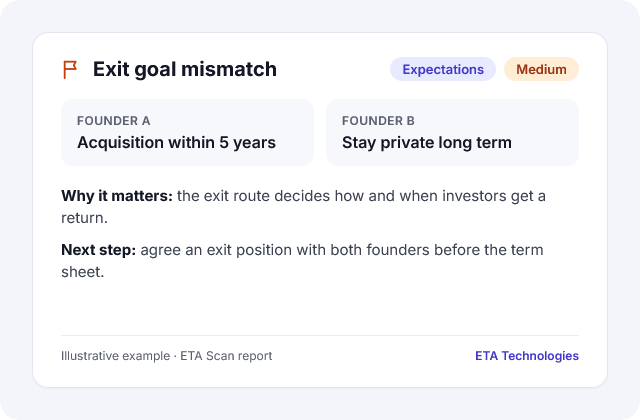
In 35% of the founding teams we assess, co-founders give different answers on their long-term goal for the company: acquisition, IPO, or staying private. Ask each founder separately, before the joint meeting, so you hear both answers.
Bring meaningful differences into the joint discussion. Ask the founders to explain their positions, agree what needs to change, and document the outcome. Assign an owner and a date to any decision still outstanding.
- Compare expectations for growth, funding, compensation, and exits.
- Explore meaningful differences with the founders before interpreting them.
- Record agreements, open questions, and the person responsible for the next step.
7. Turn the checklist into an evidence log
For each concern, record the claim, its source, the supporting evidence, the unresolved question, and the next action. Keep verified facts separate from investor interpretation. A missing document should be recorded as unavailable until it is provided or its absence is explained. It should not silently become a negative score.
Prioritise follow-up by materiality. An unclear intellectual property assignment or a founder departure provision may need resolution before signing; an incomplete operating cadence may be a support issue to address with the team. The investment committee should be able to see why an issue matters and what evidence would change the current view.
- Use the same claim, evidence, uncertainty, and next-action fields across teams.
- Assign an owner to each material unresolved issue.
- Record which questions are resolved, still open, or referred to an adviser.
Put this checklist to work with ETA Scan
We've assessed 20,000+ startup teams. ETA Scan brings that experience into your founder diligence, analysing 25+ team risk patterns across commitment, expectations, and alignment. Each founder answers separately, so you can compare individual perspectives before the joint conversation.
Our structured report gives you a focused starting point for follow-up: which differences deserve attention and where to dig deeper. Bring it into your existing deal notes and use the checklist above to turn the findings into specific actions.
Get your first scan free. Bring a startup team you're evaluating and book a call to get the scan started.
Common questions about the checklist
When should founder diligence begin? An initial review can start during early conversations, with deeper checks as the investment becomes more likely. Scope the process to the stage and decision, and avoid collecting information that has no relevance to the proposed investment.
What should the completed checklist produce? A concise evidence log covering the team's strengths, material open questions, and the actions needed before the investment decision. Use it to brief the investment committee and structure the next founder conversation.
What if a founder cannot provide an answer? Record the gap, explain why it matters, and agree a reasonable follow-up. Distinguish a document that is still being prepared from contradictory accounts or an issue that cannot be resolved before the decision.
Further reading
- William Carmody & Co: Due Diligence Demystified
Context on the wider financial, legal, operational, and founding-team diligence workstreams.
- 25 Questions to Ask Founders Before Investing
Start with your next founding team
Put our experience assessing 20,000+ startup teams to work in your next investment review. Book a call to get your first scan started, free.
Get your first scan free